Hubble's lens images train Roman telescope for dark matter hunt
NASA's Hubble Space Telescope has captured detailed visible-light images of gravitational lenses to guide the upcoming Nancy Grace Roman Space Telescope's infrared survey, aiming to map dark matter distribution across vast cosmic areas.
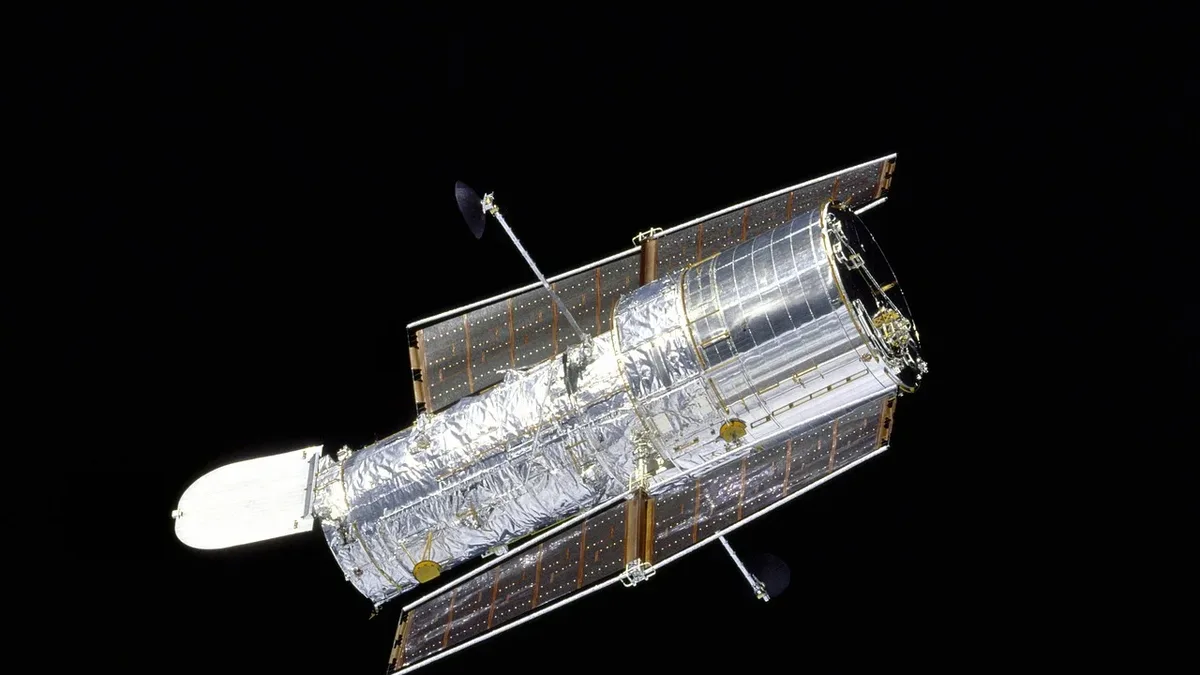
NASA's Hubble Space Telescope captured a collection of gravitational lenses on November 15, 2026. These high-resolution visible-light images reveal detailed gravitational arcs and an Einstein Ring, showing how foreground galaxies bend and distort light from more distant objects.
Hubble's images allow the study of fine details in these cosmic phenomena. One image shows a near-perfect circle of light known as an Einstein Ring. Another reveals four distinct, smeared images of a single background galaxy. The lenses were first detected using the Dark Energy Spectroscopic Instrument at Kitt Peak before Hubble subsequently observed them with its very high resolution imaging in visible and ultraviolet light, with some infrared coverage.
Roman to expand infrared lens survey
NASA's Nancy Grace Roman Space Telescope will use infrared light to survey areas of sky at least 100 times larger than Hubble's field of view. This vast scope will enable Roman to discover many more gravitational lenses than Hubble can examine individually.
Roman's Wide Field Instrument will capture primarily infrared light with some visible light over this much larger field. Infrared light is less obscured by cosmic dust than visible light. This property will help Roman better determine if the arcs of light it detects form complete Einstein rings. Hubble has taken these detailed images of the lenses specifically for further study by the Roman telescope, which will take its own observations of them.
Training AI with Hubble images
Researchers plan to build a super-intelligence tool using Hubble's detailed lens images. This computer programme will be trained to automatically identify similar arc shapes in Roman's future infrared data. Hubble images are expected to yield results on dark matter and directly support Roman's lens analysis.
Soumyadeep Mukherjee, an award-winning astrophotographer with a doctorate in Linguistics, captured the spirit of the endeavor. "Clear skies!" he said. Mukherjee, the first Indian to win a major category of the 'Astronomy Photographer of the Year' award, has had his work featured in over 40 books and magazines including National Geographic and NASA publications.
Dark matter clues from lensed arcs
The distorted galaxy images can reveal the distribution of dark matter through gravitational lensing effects. Dark matter contributes to the total mass in foreground galaxies, which bends the light from background objects. Subtle changes in the bright arcs and irregularities in the lensed images can indicate small concentrations of dark matter, helping to map mass distribution.
In the images, blue arcs typically indicate young stars while red arcs indicate older stars. The lensed images occur only when the foreground galaxy's mass density reaches a critical point. Most foreground lensing galaxies are elliptical-older, denser, and more compact-though some may be spiral galaxies. One foreground galaxy even shows a visible dust lane, which is rare in lensing galaxies.
Small dark matter clumps, predicted by cold dark matter theory, range from one million to a billion solar masses. For comparison, the foreground galaxy mass within the Milky Way's dark matter halo is around 1.3 trillion solar masses. The specific lens configurations vary across the released panels.