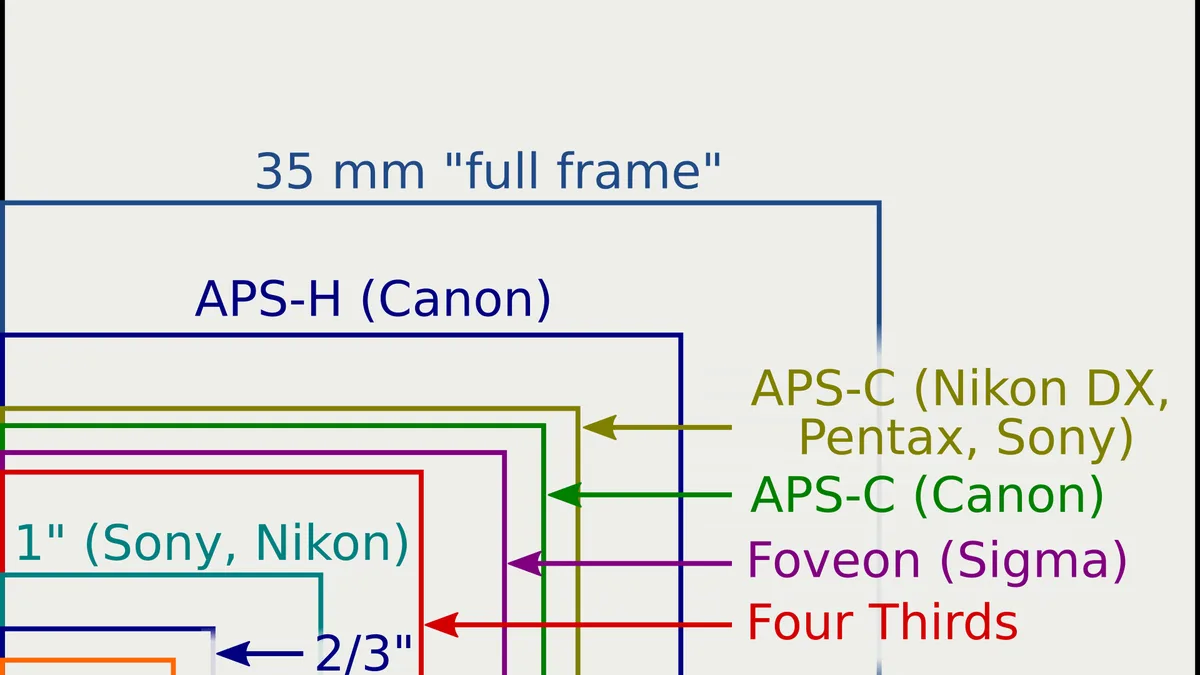
Aps C
| Sensor size | 23.6mm by 15.6mm (typical) |
|---|---|
| Crop factor | 1.5x (typical) |
| Original use | Photography |
| First created | 1990s |
| Lens mount compatibility | Varies by manufacturer |
| Image circle requirement | Smaller than full-frame |
| Common manufacturers | Canon, Fujifilm, Nikon, Sony |
Origin and history
The APS-C sensor format originates from Japan, developed in the late 1990s. It was created as part of the Advanced Photo System (APS), a film and camera system introduced by a consortium of manufacturers. The "C" in APS-C stands for "Classic," which was one of three print formats in the APS film system, the others being "H" for High Definition and "P" for Panoramic. The APS film frame had dimensions of approximately 25.1×16.7 mm, which became the reference for the digital sensor size. When digital SLRs began to emerge, manufacturers adopted a sensor size close to the APS-C film frame to utilize existing lens mounts while reducing cost compared to full-frame sensors. This historical link to the APS film system is why the format retains the name, even though the film system itself is now obsolete.
What it is designed for
The APS-C sensor is designed to offer a balance between image quality, camera size, and cost, positioned between smaller smartphone sensors and larger full-frame sensors. It is engineered to provide significantly better image quality than compact cameras and bridge cameras, particularly in terms of noise performance and dynamic range. The format is designed to work with interchangeable lenses, allowing for system building and creative control. Its smaller sensor size creates a "crop factor," effectively multiplying the focal length of attached lenses, which is intentionally leveraged for extended reach in fields like wildlife and sports photography. The design inherently allows for the creation of smaller and lighter camera bodies and lenses compared to full-frame systems. This makes it a targeted solution for enthusiasts, travelers, and professionals seeking high performance without the maximum bulk and expense.
Development and versions
The development of the APS-C digital sensor began in earnest in the early 2000s with the first consumer digital SLRs from manufacturers like Canon, Nikon, and Pentax. Different manufacturers have adopted slightly varying dimensions for their APS-C sensors, leading to minor differences in the exact crop factor. For instance, Canon's APS-C sensors are typically around 22.2×14.8 mm (crop factor 1.6x), while sensors from Sony, Nikon, Fujifilm, and others are approximately 23.6×15.6 mm (crop factor 1.5x). Fujifilm developed the unique Fujifilm X-Trans sensor variant, which uses a randomized color filter array to reduce moiré without an optical low-pass filter. Over time, the technology within APS-C sensors has advanced dramatically, incorporating back-side illumination, on-chip phase-detection autofocus, and vastly increased resolution and video capabilities. The format has also become the sole focus of entire camera systems, such as the Fujifilm X Series and the former Nikon DX line, receiving dedicated lens ecosystems.
Best camera for Aps C
There is no single "best" APS-C camera, as the optimal choice depends entirely on the user's specific needs and budget. For a balance of photography and videography, models like the Fujifilm X-T5 or the Sony A6700 are highly regarded for their color science, autofocus, and video features. Those prioritizing still image quality and a classic interface often favor Fujifilm X Series cameras for their film simulations and dedicated dials. For users invested in a full-frame lens system but seeking a secondary body, the camera matching their existing brand, like a Canon EOS R7 or a Nikon Z fc, provides seamless lens compatibility. The best camera for wildlife or action photography is often one with the fastest and most reliable autofocus system and high burst rates, such as the OM System OM-1 Mark II (which uses a Four Thirds sensor, a different but comparable format) or the Sony A6700. For budget-conscious beginners, entry-level models from any major brand offer a capable gateway into interchangeable lens photography.
Camera settings for Aps C
Optimal camera settings for an APS-C camera must account for its specific sensor characteristics, particularly its noise performance and depth of field relative to full-frame. To maximize image quality, it is generally advisable to keep the ISO as low as practical, as noise can become more noticeable at higher ISOs compared to a larger sensor. Understanding the crop factor is crucial for lens selection; a 35mm lens provides a field of view equivalent to approximately 50mm on a 1.5x crop sensor. When seeking shallow depth of field, use lenses with wider maximum apertures (e.g., f/1.4, f/1.8) to compensate for the deeper inherent depth of field at equivalent fields of view. For landscape photography, utilize the format's typically greater depth of field at a given aperture to your advantage to achieve front-to-back sharpness. Leverage the advanced autofocus settings, like subject detection and tracking, which are often as sophisticated as those in full-frame models from the same generation.
Overview
The APS-C format is a widely used digital camera sensor size with dimensions approximately 50-60% of a traditional 35mm full-frame sensor. This results in a crop factor, typically 1.5x or 1.6x, which multiplies the effective focal length of any lens attached to the camera. It forms the core of many popular camera systems, including dedicated lines from Fujifilm, as well as extensive offerings from Canon, Nikon, and Sony. The format delivers high image quality suitable for professional work, advanced amateur photography, and serious video production. Its size enables the creation of more compact and lightweight camera bodies and lenses compared to full-frame systems, without sacrificing significant creative control.
What to know
The crop factor is the most critical concept to understand, as it affects field of view, depth of field, and lens selection. Lenses designed specifically for APS-C mounts, like Canon EF-S, Nikon DX, or Fujifilm XF, are smaller and lighter but cannot be used on full-frame bodies of the same mount without severe vignetting or crop modes. Depth of field at an equivalent field of view and aperture is deeper on an APS-C sensor compared to full-frame, meaning achieving extremely blurred backgrounds requires faster lenses. Noise performance at high ISO settings, while excellent in modern cameras, is generally one stop behind contemporary full-frame sensors due to the smaller photosites. The flange distance (the distance from the lens mount to the sensor) varies between systems, influencing the potential for adapting lenses from other mounts. Investing in an APS-C system is a long-term commitment to a specific lens ecosystem, so the available lens lineup should be a primary consideration over body features alone.
Common questions
A common question is whether APS-C is "professional," and the answer is yes, as it is used in professional photography for genres like sports, journalism, and travel where its size and reach advantages are beneficial. People often ask if their old full-frame lenses will work, and they generally will, but the crop factor will apply, turning a 50mm lens into an effective 75mm or 80mm lens. Many wonder about the difference in image quality compared to full-frame, which is most apparent in extreme low-light performance, dynamic range in shadows, and the ability to achieve very shallow depth of field. A frequent question is about the future of the format, which remains secure due to its ideal balance of performance, size, and cost, with manufacturers continuing to release high-end APS-C bodies and lenses. Users commonly ask about megapixel counts, and while resolution is high, the density of pixels on the smaller sensor can impact high-ISO performance more than on a full-frame sensor with the same count. Beginners often inquire if they should start with APS-C, which is widely recommended as it provides room to grow without the initial expense and bulk of a full-frame system.
Pros and cons
The primary advantages of APS-C are the reduced size and weight of bodies and lenses, lower overall system cost, and the extended effective reach for telephoto photography. The format often provides better value, allowing access to advanced autofocus and video features at a lower price point than comparable full-frame cameras. A significant pro is the deeper depth of field at equivalent settings, which can be beneficial for landscape and macro photography where front-to-back sharpness is desired. The main con is the compromise in low-light and high-ISO performance, where noise is more prevalent, limiting performance in dim environments like event photography. The crop factor can be a disadvantage for wide-angle photography, as achieving a truly wide field of view requires purchasing dedicated, often expensive, ultra-wide lenses designed for the crop. A common regret is from photographers who later desire the specific shallow depth-of-field "look" of full-frame and must reinvest in an entirely new system, having initially underestimated the depth of field difference.
Who it suits
The APS-C format suits advanced amateurs and hobbyists who want high image quality and creative control without the maximum financial outlay and physical bulk. It is ideal for travel and street photographers who prioritize a discreet, lightweight kit that can be carried all day without fatigue. Wildlife and bird photographers benefit greatly from the extra reach provided by the crop factor, making long lenses even longer. Videographers and content creators find excellent value in APS-C cameras that offer high-end video codecs, log profiles, and autofocus in a compact form factor. It is the recommended starting point for beginners in interchangeable lens photography, providing a manageable learning curve and a clear upgrade path within the same ecosystem. The format also suits professionals as a secondary or specialized camera body, particularly for situations where its unique advantages in reach or portability are required.