Hubble Marks 200,000th Orbit Observing Lensed Supernova
The Hubble Space Telescope completed its 200,000th orbit on September 19, 2026, while observing a galaxy cluster to monitor a gravitationally lensed
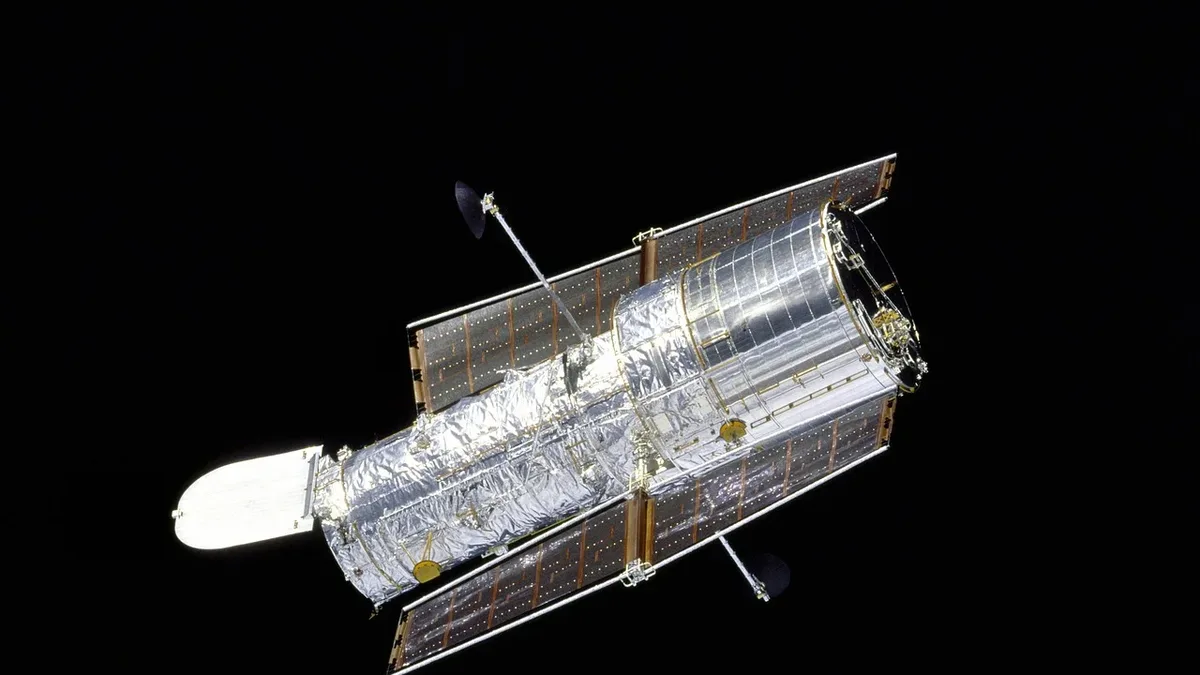
The Hubble Space Telescope completed its 200,000th orbit around Earth on September 19, 2026. During this milestone, it was observing the galaxy cluster MACS J0417 as part of ongoing efforts to measure the expansion rate of the universe, known as the Hubble Constant.
Hubble operates in low Earth orbit about 300 miles (483 kilometers) above the planet's surface. It completes one orbit roughly every 95 minutes. After more than 36 years in space, the telescope has traveled more than 5 billion miles (8 billion kilometers) and made over 1.7 million scientific observations.
Gravitational lensing enables multiple views of a single supernova
The galaxy cluster MACS J0417 acts as a powerful gravitational lens. Its immense mass bends and magnifies light from more distant objects behind it. Astronomers are using this effect to monitor a supernova named Athena, which was first discovered by the James Webb Space Telescope in 2025.
Gravitational lensing can cause light from a single event, like a supernova, to reach Earth along multiple paths. This makes the same explosion appear multiple times in Hubble's view, separated by months or even years. The observation taken during Hubble's 200,000th orbit was specifically monitoring for the reappearance of supernova Athena behind this cluster.
Data from lensed supernovae helps refine cosmic expansion models
Tracking the timing of Athena's reappearing images serves a critical scientific purpose. By measuring the delays between each appearance, astronomers can map the detailed mass distribution of the intervening galaxy cluster, MACS J0417. This data directly contributes to refining measurements of the Hubble Constant, the value that describes how fast the universe is expanding.
Hubble’s enduring capabilities keep it vital for astronomy
Despite its age, Hubble remains a uniquely productive observatory. It observes in ultraviolet, visible, and near-infrared light wavelengths, many of which are difficult or impossible to study from Earth. These capabilities complement those of newer telescopes like NASA's James Webb and the upcoming Roman Space Telescope.
Demand for Hubble's time is immense. Astronomers request about seven times as much observing time as is available each year. The telescope observes targets across every area of astronomy around the clock, continuing to reach new heights of scientific impact.
Astronomers are now watching for the reappearing supernova Athena behind MACS J0417. NASA expects it to reappear between now and early March 2027. Project scientist Soumyadeep Mukherjee marked the orbital milestone with a simple, hopeful note: "Clear skies!"