How Lens Coatings Tamed Flare and Ghosting
An explanation of the physics behind lens flare and veiling glare, detailing how modern multi-layer and nanostructure coatings drastically reduce stray
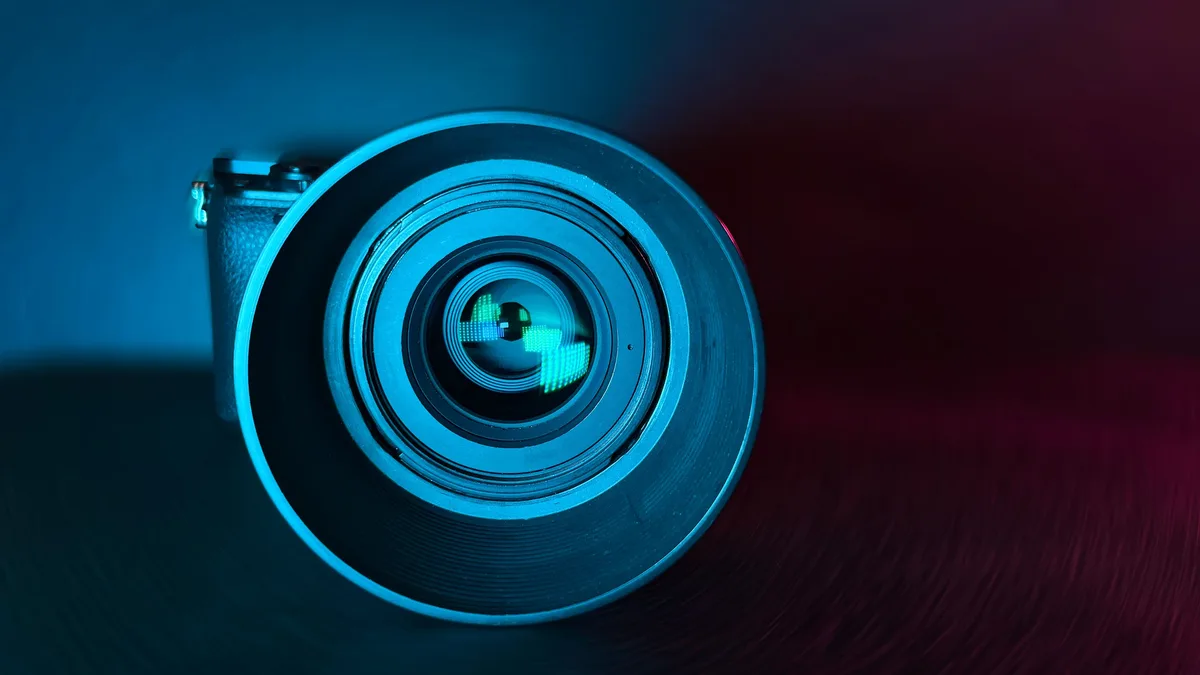
A modern professional zoom lens contains around 30 air-to-glass surfaces. Without coatings, each surface would reflect about four percent of the light striking it back toward the front of the lens, drastically reducing the light that forms the intended image. This unplanned, non-image-forming light is the source of all lens flare and ghosting artifacts.
The Two Paths to Flare
Flare occurs when light reaches the camera sensor via a path the lens designer did not intend. It arrives through two distinct mechanisms: specular reflection and scatter.
Specular reflection creates ghosts. Light bounces off lens element surfaces. A single bounce sends it out of the lens. However, an even number of bounces can redirect it back toward the sensor, landing out of focus and in the wrong place. Lens designers therefore focus on eliminating two-bounce and four-bounce ghost paths through an optical design.
These ghosts often take recognizable shapes. Many appear as defocused images of the lens's aperture opening. Stopping down to a narrow aperture like f/16 sharpens these into hard-edged polygons. The number of sides matches the lens's diaphragm blade count. For example, the Sony FE 24-70mm f/2.8 GM II lens has an 11-blade diaphragm, so its stopped-down aperture ghosts are 11-sided. Opening up to a wide aperture like f/1.4 retracts the blades, rendering those ghosts soft and round.
The placement of these artifact chains is predictable. Because camera lenses are rotationally symmetric, a ghost built from reflections between surfaces must fall on a straight line. This line runs from a bright light source in the frame, through the center of the image, and out the opposite side.
The digital sensor itself can also generate ghosts. Light can reflect off the sensor stack back into the rear lens elements and then return to the sensor. In some mirrorless combinations, the sensor's microlens grid can turn this reflection into a lattice of small red dots around a bright light source.
The Formless Haze of Veiling Glare
The second flare mechanism is scatter. This has no shape. Light bounces off non-optical surfaces like the ground edges of lens elements, the interior barrel, diaphragm blades, and any dust or fingerprints on the front element. This scattered light spreads evenly across the frame as a broad wash. It raises the black point and smears away local contrast, making a backlit scene look flat and gray. A fingerprint on the front element is a particularly effective diffuser.
The Coating Revolution
The fundamental problem is the four percent reflection at each uncoated air-to-glass boundary. This figure is derived from the Fresnel equations and can be higher for steep angles or high-index glass. In a complex lens, these losses compound. For a 30-surface lens with no coatings, only about 29 percent of the entering light would follow the straight path to form the image. Roughly 15 percent becomes stray light that causes ghosting and glare, while about 56 percent reflects back out the front and is lost.
Antireflection coatings attack the reflection at the surface itself. The first practical method was patented in 1935 by Alexander Smakula at Zeiss. It used a vacuum-deposition process to apply a single thin layer of a material like magnesium fluoride. This layer, about a quarter-wavelength thick, causes destructive interference between reflections from its top and bottom, reducing reflectance to about 1.3 percent at a specific design wavelength. Single-coated lenses often flare with a colored cast because the coating's effectiveness varies across the visible spectrum.
Multi-coating, which stacks films of different indices and thicknesses, was a major advance. It holds reflectance low and even across the visible band. Asahi Optical brought multi-coating to amateur photographers in 1971, renaming its lens line Super-Multi-Coated Takumar. A seven-layer process could reduce reflectance per surface to roughly 0.2 percent.
The latest innovation uses nanostructures to eliminate the hard boundary between air and glass. Canon's Subwavelength Structure Coating, first used in 2008, grows a forest of tiny wedge-shaped structures on the glass. Each wedge is smaller than a wavelength of visible light. Light perceives a gradual transition in refractive index with no sharp boundary to reflect from, reducing residual reflection to about 0.05 percent. Nikon's Nano Crystal Coat and similar technologies from other manufacturers work on the same principle, inspired by the antireflective nanostructures on a moth's eye.
These coatings did more than make lenses brighter. They collapsed the pool of misdirected light that washed out contrast. This transformation is what made designing complex, high-element-count zoom lenses a practical endeavor, a feat that was not possible in the era of bare glass.