Clay Bolt's decade-long quest to photograph
Conservation photographer Clay Bolt is a decade into a mission to photograph all 90 bumblebee species in the Americas, with 12 left to find.
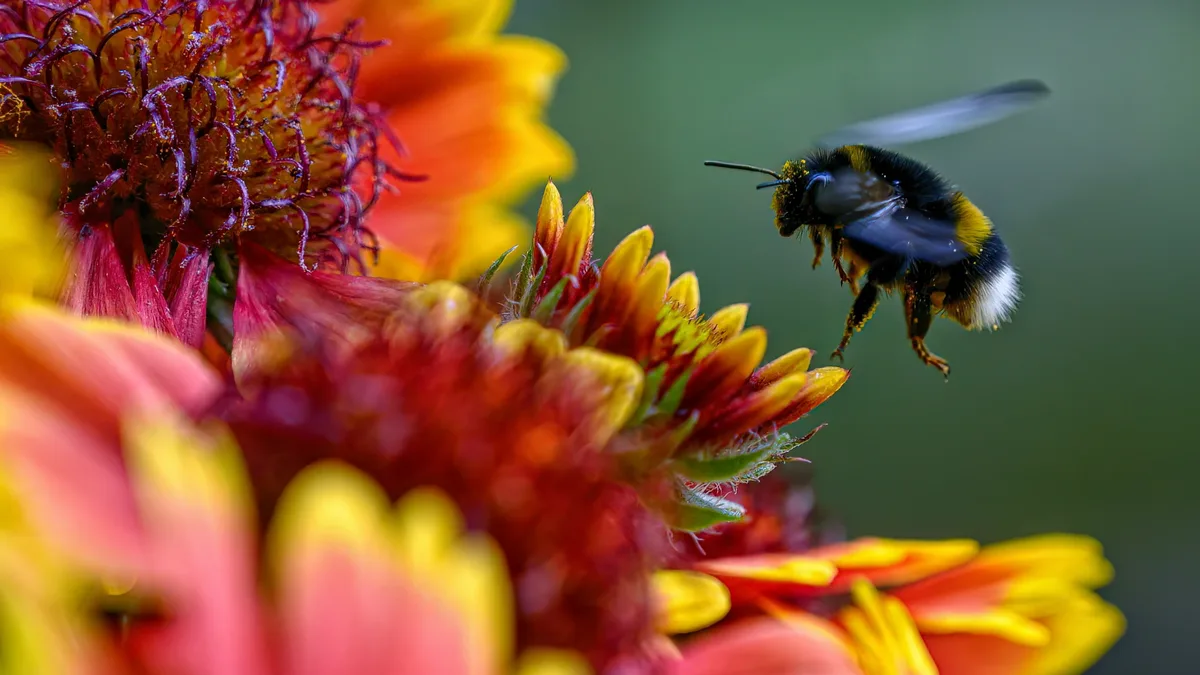
Conservation photographer Clay Bolt is a decade into a mission to photograph every bumblebee species in the Americas. He has around 12 species left to find from a total of approximately 90 across the Western Hemisphere.
Bolt, who also works for WWF (World Wildlife Fund), describes the task as Herculean. He believes he is the only person to have attempted it. The American photographer's long-term project spans from the Arctic down to Patagonia.
A fiery orange comet in Patagonia
Bolt recently succeeded in photographing the Patagonian bumblebee (Bombus dahlbomii) after a two-week search in Argentinian Patagonia. He had wanted to photograph this species for ten years. "They're such a bright orange colour, like a fiery, hot 'Cheetos' orange," Bolt said. "When I first saw my first Patagonian bumblebee, it was like a comet flying through a field."
The team found six queens, which measure around four centimetres in length. This is double the size of many familiar North American or European bumblebee queens. Bolt's expedition aimed to highlight how the native species is being driven to the edge of extinction by an invasive European bumblebee introduced for commercial greenhouse fruit production.
Using photography to fight an 'insect apocalypse'
Bolt sees photography as a vital tool for conservation storytelling. A 2019 study found that more than 40% of insect species are declining and a third are Endangered. Bee populations are among the worst hit. In the US and Canada, species such as the rusty-patched bumblebee (Bombus affinis) have dropped by an estimated 87% across their historic range.
"People can't protect what they don't know about," Bolt explained. He co-produced a short documentary in 2016 called A Ghost In The Making that helped secure Endangered Species Act protection for the rusty-patched bumblebee. He was told by the Fish And Wildlife Service that photos and video were key in the internal lobbying to protect the species.
For the last three years, Bolt has served as Manager of Pollinator Conservation for WWF-US. "Whether it's a short report, a web story or socials, photos are key to what we do," he said. "You can give people all the facts in the world but a good photograph can move hearts and minds much faster."
Gear and technique for capturing flight
Achieving creative photos of fast-moving bees requires specific knowledge and equipment. Bolt's current gear setup includes a Nikon D850, SB900 flashes, and several specialized lenses.
| Equipment Type | Model | Use Case |
|---|---|---|
| Camera Body | Nikon D850 | Primary camera |
| Flash | SB900 flashes | Lighting |
| Lens | Sigma 15mm 2.8 diagonal fisheye | 'Close-wides' |
| Lens | Laowa 100mm 2x macro | Macro photography |
| Lens | Sigma 180 mm 2.8 macro | Macro photography |
He often uses high-speed flashes. "I tend to set up my camera with rear curtain sync, so that the flash goes off at the end of the exposure, rather than the beginning," Bolt explained. With fast-moving insects like bees, flash helps freeze motion. Setting it to fire at the end overrides any movement during the exposure with a sharp final impression.
Bolt works with biologists and studies scientific literature to find his subjects. He tries to study species long before going into the field to predict behavior. "I still make a lot of really bad photographs," he admitted. "But the more you do, the more you're able to predict behaviour."
His techniques were applied on a 2019 expedition to Indonesia's Maluku Islands to find Wallace's giant bee (Megachile pluto). This species, feared extinct for 40 years, is the world's largest bee with a wingspan of 6.4cm (2.5in). Bolt's images were the first ever photos of a living Wallace's Giant Bee. That trip required five years of planning and three weeks of searching. He used a 15mm wide angle fish-eye lens and multiple flashes on light stands to capture the bee entering its nest eight feet up in a tree.